UK Startup Equity and EMI Options Explained
How April 2026 widened EMI eligibility and what employees must check.

- Written by
- Marcus Delacroix-Owusu
- Published
- November 9, 2026
- Reading time
- 9 min read
- Sources cited
- 3 sources ↓
What this covers
EMI options are the main way UK startups give employees a stake in their growth. The April 2026 changes brought more companies within reach of the scheme. You also need to understand the purchase price, tax treatment, vesting terms, and paperwork that make the promised benefits work.
What EMI options are and why UK startups use them instead of salary
An EMI option fixes the price you can pay for shares later, with tax generally due only when you sell. That is the core deal for employees. The price you agreed to pay stays the same if the company’s value grows. You receive an option to buy shares, and exercising it means making that purchase, usually at an exit such as a company sale.
Enterprise Management Incentives, or EMI, help startups compete for staff when they cannot pay as much as larger employers. Salary and bonuses face income tax immediately. EMI options that qualify let employees share in what the company is worth in the future under capital gains rules. That makes equity both part of the hiring offer and a reason to stay. It gives employees a financial interest in the outcome they help build.
The contrast with unapproved options explains why EMI is the standard choice for qualifying UK startups. Unapproved option gains face employment taxes at exercise. Income Tax can be as high as 45%, plus National Insurance, and the company pays 15% employer National Insurance contributions on top. Qualifying EMI exercise avoids those charges. The company can also claim a corporation tax deduction on the option gain.
What the April 2026 rule changes actually expanded
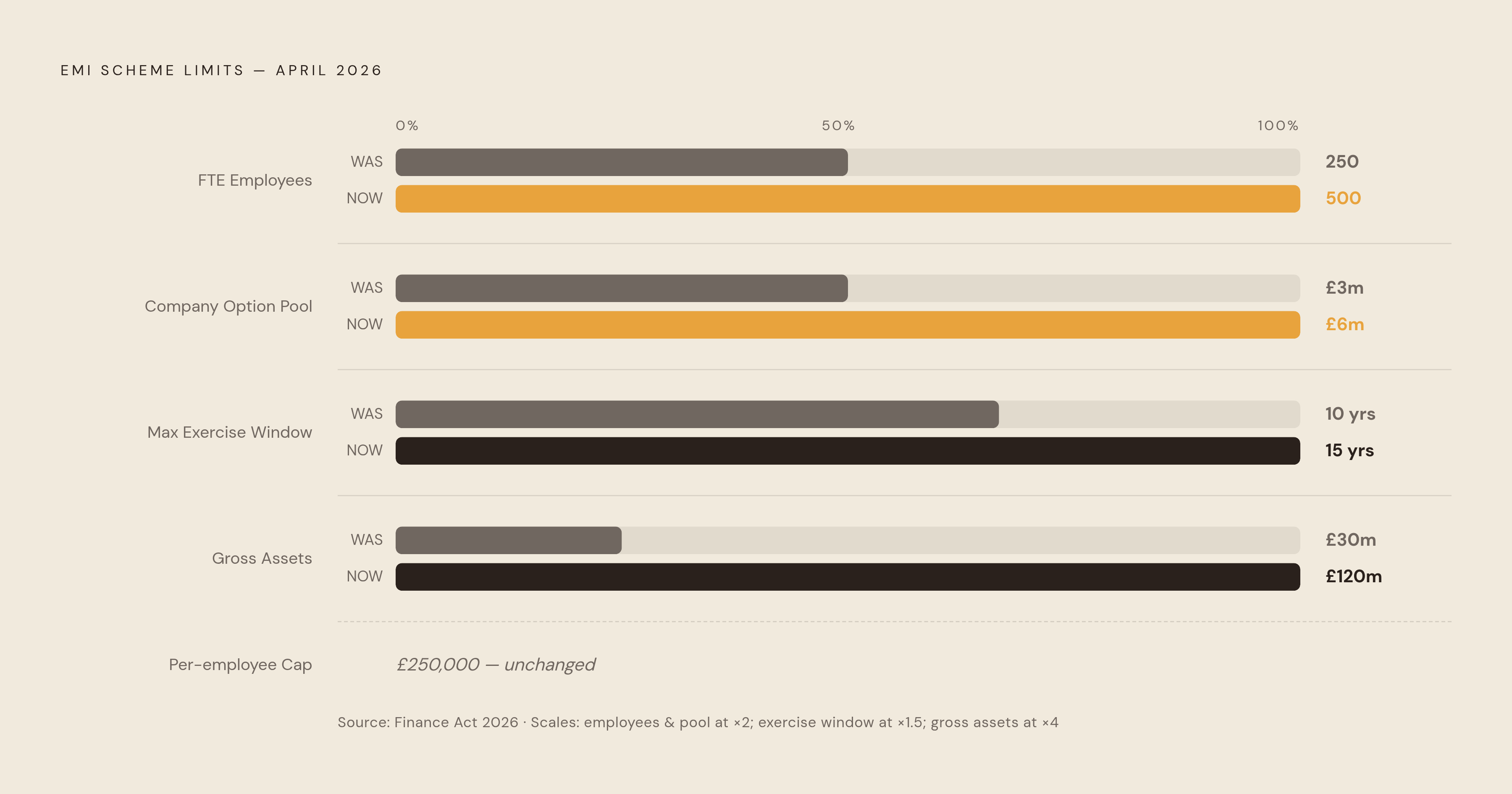
The April 2026 changes expanded which companies can grant EMI options and how long employees can hold them before exercise. The limit on headcount went up from 250 to 500 full-time equivalent employees. The company-wide option limit increased from £3 million to £6 million. The longest time allowed to exercise options went from 10 years to 15 years. The individual limit stayed at £250,000 per employee.
The expanded gross-assets limit is £120 million. Together, these limits bring a wider range of funded companies within EMI’s scope. A business previously too large for EMI may now qualify. That includes companies that moved to another tax-advantaged share option scheme or to unapproved options. They can reassess eligibility against the new limits rather than assume their earlier exclusion still applies.
The grant date determines which scheme limits apply. HMRC’s ERS Bulletin 64 says the original scheme limits still apply to options granted on or before 5 April 2026. The longer exercise window can also apply to existing unexercised options through properly documented agreement amendments. The options keep their tax-advantaged status when that is the only change. A separate change removes per-grant HMRC notification from April 2027, but the 6 July deadline applies until then.
The four eligibility tests a company must pass before granting EMI
A company must pass four tests at each grant date, starting with its gross assets. Those assets must total no more than £120 million. The second test measures headcount across the group. It must have fewer than 500 full-time equivalent employees.
The third test asks whether the company is independent. Another company must not control it through a majority parent relationship. This excludes many private-equity-controlled companies from the scheme. Options must cover shares in the parent company, and that parent must itself meet the independence test.
The fourth test looks at the company’s actual trade. EMI excludes certain activities, including banking, insurance, money-lending, and other financial activities. If excluded activities account for more than 20% of the company’s activity, the whole company fails. This test needs judgment. A company uncertain about its trade can ask HMRC for advance assurance before granting options.
The company must pass all four tests each time it grants options. A company that qualified at seed may fail at Series A because its business has changed. An older grant to another employee does not establish eligibility for yours.
The trade test in practice, and why it catches fintech and software companies by surprise
The trade test remains relevant after options have been granted. A company can start with qualifying activities and later move into an excluded trade. Calling the company a software or platform business does not show that it qualifies. What the business actually does determines the risk. That makes a change in business model significant for employees as well as founders.
Balance-sheet lending is a concrete example for fintech companies. If a platform starts lending from its own balance sheet, that creates a disqualifying event. HMRC’s internal manual says option holders have 90 days to exercise and keep the tax advantages. Any growth in value after that window falls outside the EMI tax advantages. A product decision can therefore create an exercise deadline for employees.
EMI uses the same excluded-activities test as SEIS and EIS. A fintech qualifying under those schemes will usually pass EMI’s trade test, but that does not settle its other eligibility tests. For founders considering lending, the lesson is to include option consequences in the decision with FCA permissions. Employees also need to know how the business model is changing. If that describes your employer, ask whether it has confirmed the trade test in writing at each grant cycle.
Which employees qualify and who is excluded from EMI
You must meet the rules for employees even if your employer passes every company test. Contractors, advisers, and non-executives cannot be given EMI options. Employees must meet the scheme’s working-time test. That means at least 25 hours a week for the company, or at least 75% of total working time. Employees must also give a written declaration confirming that they meet this test.
Part-time work does not automatically rule you out. The proportion of your working time spent with the company can determine eligibility. Significant consulting work elsewhere can therefore affect the result. A role’s title alone cannot answer this question.
The material-interest test limits eligibility for controlling founders. At grant, an employee must not hold more than 30% of the company’s shares, counting connected persons. This rarely affects non-founder employees, but it can prevent founders from awarding themselves additional EMI options. The rule applies separately from the working-time test. Meeting one does not remove the other.
The £250,000 individual limit also affects repeat grants. If a second grant breaches the limit, the entire second grant fails. Exercising options leaves fewer unexercised options, so further grants can bring the balance back up to the limit. Larger senior-hire packages therefore need supplementary arrangements. Growth shares or unapproved options commonly cover the balance.
The tax treatment at grant, exercise, and sale
EMI has no Income Tax or National Insurance charge at grant. Exercise also avoids both charges when the exercise price meets the market value agreed with HMRC at grant. A discounted grant changes that treatment. Income Tax applies to the discount if the exercise price falls below that value. The agreed price is therefore part of the tax calculation.
At sale, the gain falls under Capital Gains Tax. The higher rate is 24% for 2026/27. Business Asset Disposal Relief, or BADR, can reduce that rate to 18% on qualifying lifetime gains. That lower rate depends on meeting the relief’s conditions. An EMI label alone does not establish entitlement.
EMI makes BADR more accessible in two specific ways. It waives the normal minimum shareholding requirement. It also starts the two-year qualifying clock at grant. An employee can therefore qualify even if they sell the shares soon after buying them. The grant date has a direct role in the eventual tax treatment.
For the same option gain, unapproved options create a different tax calculation. At exercise, the gain faces up to 45% Income Tax plus National Insurance. Qualifying EMI instead leaves the gain subject to capital gains treatment at sale. The employer may also have to pay 15% employer National Insurance contributions on unapproved options. These rates describe different stages, so comparing only the final sale proceeds misses part of the cost.
The company’s EMI deduction uses the gain at exercise. That gain is the market value at exercise minus the exercise price. For an employee evaluating an offer, the useful comparison includes both the price paid and the applicable tax treatment. It also distinguishes exercise from sale. Those events may happen together, but the distinction becomes important when they do not.
How to set up an EMI scheme and meet the 6 July deadline
The setup sequence starts with the valuation before grant. A specialist submits Form VAL231 to HMRC to agree the share value. It usually takes four to six weeks for HMRC’s response to arrive. It gives the agreed Unrestricted and Actual Market Values used to establish the exercise-price floor. Granting before this process is complete risks an unexpected Income Tax charge at exercise.
The company then needs option agreements and scheme rules. HMRC does not offer a model agreement for this purpose. Each grant needs a written agreement setting out any share restrictions. Employees’ working-time declarations must also be in writing at grant. These documents connect the offer’s terms to the conditions behind its tax treatment.
The current notification deadline is 6 July after the tax year in which the grant was made. The company must tell HMRC about the grant through the Employment Related Securities service, known as ERS. This deadline deserves particular attention during setup. Missing it can put the expected EMI treatment at risk and leave an employee facing an unwelcome tax liability.
The notification rule changes for grants from April 2027. Per-grant notification will end, while the annual ERS return will continue. Until then, companies still need to meet the applicable 6 July deadline. Candidates who know which notification rule applies can tell whether a grant is complete or still needs paperwork.
What vesting schedules look like and how option pools are sized at different stages
Your vesting schedule and fully diluted ownership help explain what an equity offer means. The schedule sets out when you earn the options. The pool is the equity set aside for employee awards, while your grant is the part set aside for you. Neither tells the whole story alone. A grant’s value depends on its terms and the company’s stage, as well as its tax treatment.
Ask what the vesting schedule means for your grant and how the company explains its terms. The same percentage can mean different things at different stages. A company’s current share structure is only part of that picture. Later financing can change your percentage before an exit.
Dilution is a normal part of startup funding. Companies typically raise several rounds, each diluting existing shareholders. A seed-stage stake can become a smaller percentage by exit without anyone acting in bad faith. The useful ownership figure is therefore fully diluted ownership. It accounts for issued shares, options, warrants, and convertible instruments.
Clear numbers make this conversation easier for both sides. Ask for the fully diluted share count. Ask for the current HMRC-agreed valuation from the VAL231. Worked exit scenarios at several valuations also help explain the offer’s assumptions. These give you something concrete to assess. Descriptions of an offer as generous cannot substitute for its terms.
When EMI does not apply and what the alternatives are
EMI is generally the best available UK employee equity structure when both the company and the employee qualify. Its limits still leave people and companies outside it. CSOP and unapproved options are alternatives for companies beyond EMI’s scope. Growth shares can also form part of an equity package. These structures need their own assessment rather than being treated as interchangeable versions of EMI.
A package above the £250,000 individual limit often has growth shares or unapproved options alongside EMI. Each part can have a different tax outcome. If you receive unapproved options, model the tax charge at exercise explicitly. Income Tax can become due before a sale gives you cash to pay it.
The most useful offer questions go beyond whether the scheme is EMI. What is your tax treatment at each stage? What assumptions support the valuation? Founders who answer those questions plainly make the offer easier to judge. For candidates, a clear account of the structure and its limits is part of an honest hiring conversation.
Methodology & sources
- EMI Share Options for Fintech Startups: The 2026 Rules, and the Qualifying-Trade Catch
Supplied the 2026 limits, the 20% excluded-activities threshold, the trade-test fintech example, and the 2026/27 CGT rate.
- EMI Share Options Explained: A UK Founder’s Guide for 2026/27
Covered the EMI scheme limits, eligibility tests, tax treatment versus unapproved options, and the 15% employer National Insurance rate.
- Equity Compensation for UK Startups: A Comprehensive Guide
Provided background on vesting, option pool sizing, dilution and EMI as startup equity compensation.